What is AI Reputation Management? The New Online Reputation Management?
- AI reputation management is work with what Google and AI say about your brand when people check it. We call it Answer Reputation Management.
- For brand questions like "is [your brand] legit?" there is almost no competition. The question is what the answer says about you and where it takes it from.
- AI often puts the answer together from old reviews, old risk numbers, Trustpilot profiles and pages where the license is not the right one anymore.
- To fix it, you go from the answer back to the sources and fix what is written there. What AI takes from the web can change in a couple of days, or it can take up to 2 months.
In simple words, the task is this: when your client is looking for you on Google or in AI models, they should find what you want them to see. This year PRpillar grew a lot, and now we work not only with reputation in Google, but also with how AI (ChatGPT, Gemini and others) describes brokers, prop firms and fintech companies. A lot of people search for it as AI reputation management or AI brand reputation. We call this work Answer Reputation Management, because what matters is the answer people get about your brand, in ChatGPT, in Google or anywhere else.
At PRpillar we've worked on the reputation of CFD brokers, prop firms and fintech companies since 2014, and here is what we see now. Before, we had Google and the Google results. Now we have Google, ChatGPT results, Grok results, Claude results, and all of it shapes reputation. So instead of one source you now have, depending on your priorities, 5 to 7, and this changes the game a lot. A few years ago the reputation part didn't even exist, and you wouldn't find a broker or a fintech company with even one ORM (online reputation management) specialist on the team. Now it's something companies do on a regular basis.
Google didn't die, by the way. Most of the traffic is still Google, and not the whole world has relearned to use AI yet. But I think in 2 or 3 years AI will be roughly the headliner in reputation.
The "is it legit?" question
If you check a lot of brokers, you will see that one question comes up again and again: "is it legit?". It's a real keyword in Google, and it's a real prompt, actually. In our November Ahrefs export (17 brands, 33 countries) "legit" shows up in all 33 countries, and among question searches "is [brand] legit" is the most common one. People search "[brand] reviews" about 4 times more, though. People ask about reviews, about withdrawals, separately about Reddit, and these are real queries people make when they check a broker's reputation before the first deposit.
Why is this important? A company spends budget on PR or on paid ads, and after this part of the users still go to Google or ChatGPT to check the brand. They don't believe a brand just because you showed them an ad or they read an article about you. So when I talk about online reputation management, it's only the part where you meet the user at the last stage, when they are close to becoming your real client (and close to the first deposit).
One user types the question into Google and gets at least 10 links. Another user goes to ChatGPT, asks more or less the same question, and ChatGPT cites its own links. And if the first one clicks "show more" in Google, it sends them into AI Mode. Search Console counts these questions too, and since August 2026 there is even a separate report for AI Overviews and AI Mode. But it shows only impressions, not the questions, so you still can't see what people asked in AI Mode. So basically, brand reputation in AI search is already a part of your reputation in Google.
How Answer Reputation Management is different from SEO
SEO usually aims to get organic traffic from non-branded keywords, like "best CFD broker". A classic SEO team just doesn't check brand questions, because they usually have no interest in branded traffic. The same with AEO (answer engine optimization, getting into AI answers): when people talk about visibility, it's mostly about non-brand keywords.
I see it as the path of one person. First they search for something general, like "best forex broker", and this is basically SEO. But in the end they still ask about a specific company, and this is where ORM starts. In AI chats it's the same: first people ask something general, like "who is the best broker", and then the chat goes on: "what is good about this broker?" or "what do reviews say about it?". And this second part you can track separately, while most AI tracking tools on the market now are tuned for the first part: are we there for "best forex broker" or not.
Brand questions are different. There's actually no competition there, because nobody else ranks for "is [your brand] legit" on purpose. It happens, but rarely, that unethical competitors or affiliates do it. So for brand questions your brand is almost always in the answer. The question is what the answer says about you, and where it takes it from. And AI search reputation management is exactly about this.
What AI visibility tools miss in brand-related prompts
There are a lot of AI visibility and AI reputation management tools now, but most of them are not made for a specific industry like CFD and work the same way for every business. You put in your website, they collect some data from it, and then ask ChatGPT to create the prompts. This kind of data is usually too artificial. Then companies think they are really tracking visibility, but they are not, and they make decisions on this data for months. It's not because the system is wrong. It's just because the initial prompts were wrong. That's why every industry needs its own approach to which prompts to take, both brand-related and non-brand ones: AI systems don't have open statistics like Google has for keywords. And this step needs a lot of attention.
What PR has to do with it
We understand that PR is quite important. Still, it's totally different work. PR brings people to the brand: a company spends budget on articles or ads, and people hear about it. Then they go to check the brand, and this is already reputation. But there is one thing: AI takes media articles as sources for its answers. So a good article in a normal media outlet works twice: people read it, and AI cites it.
Why AI answers about brokers go wrong
LLMs like to gather information from different sources and combine it, and these sources are often not what you see on the first page of Google: our monitoring shows how much AI sources differ from search results. For one or two prompts AI sends multiple queries to the web, usually low-frequency ones that people don't type. And because of this it finds pages that a normal person would never get to. So LLM reputation management starts not from the answer, but from the sources.
In October 2026 our team checked open data on brokers. Here is what we found:
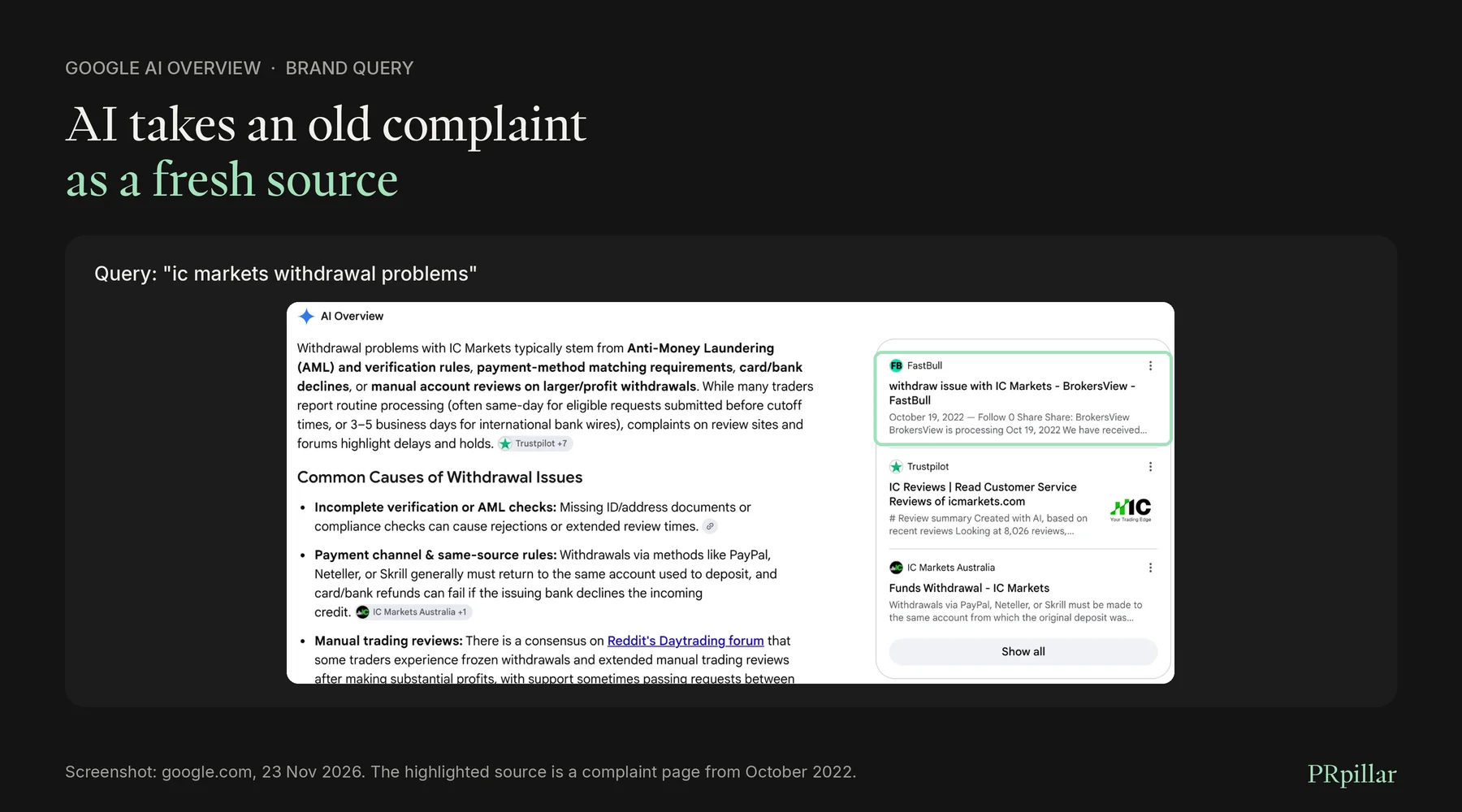
Outdated reviews look fresh in an AI answer. AI can take reviews, Reddit and Quora threads with information that is already not true or outdated, and still use it as the main thing about what users say. If a company doesn't watch its reputation and what users write about it, this happens, and we see it regularly. Before, users went to these platforms themselves, saw that the reviews were old, a year old for example, and didn't really believe them. Now an AI system just gives an answer, and it may not even say that this review is from 2015. So the user takes the AI answer as reality right away, without double-checking. For example, we've seen well-licensed brokers with an old Reddit thread about a scam and unreliable withdrawals, and AI said that this company has problems, although it was just a very old, outdated thread.
Comparison sites with old risk figures. Look, a CFD broker regulated in the UK or the EU must show this "X% of retail investor accounts lose money" banner. And the number there changes once a quarter, because the FCA rules (COBS 22.5) and the ESMA measures on CFDs say brokers have to recalculate it every three months for the last 12 months. On 22 October we went through 102 review and comparison pages and checked them against what the brokers have on their own sites now. The right number was only on 32 of them, that's 31%. On 22 it was old or even someone else's, on 16 some general range, and on 32 there was no number at all. And AI reads these pages and just repeats what is written there, so it gives people the wrong information about your risk.
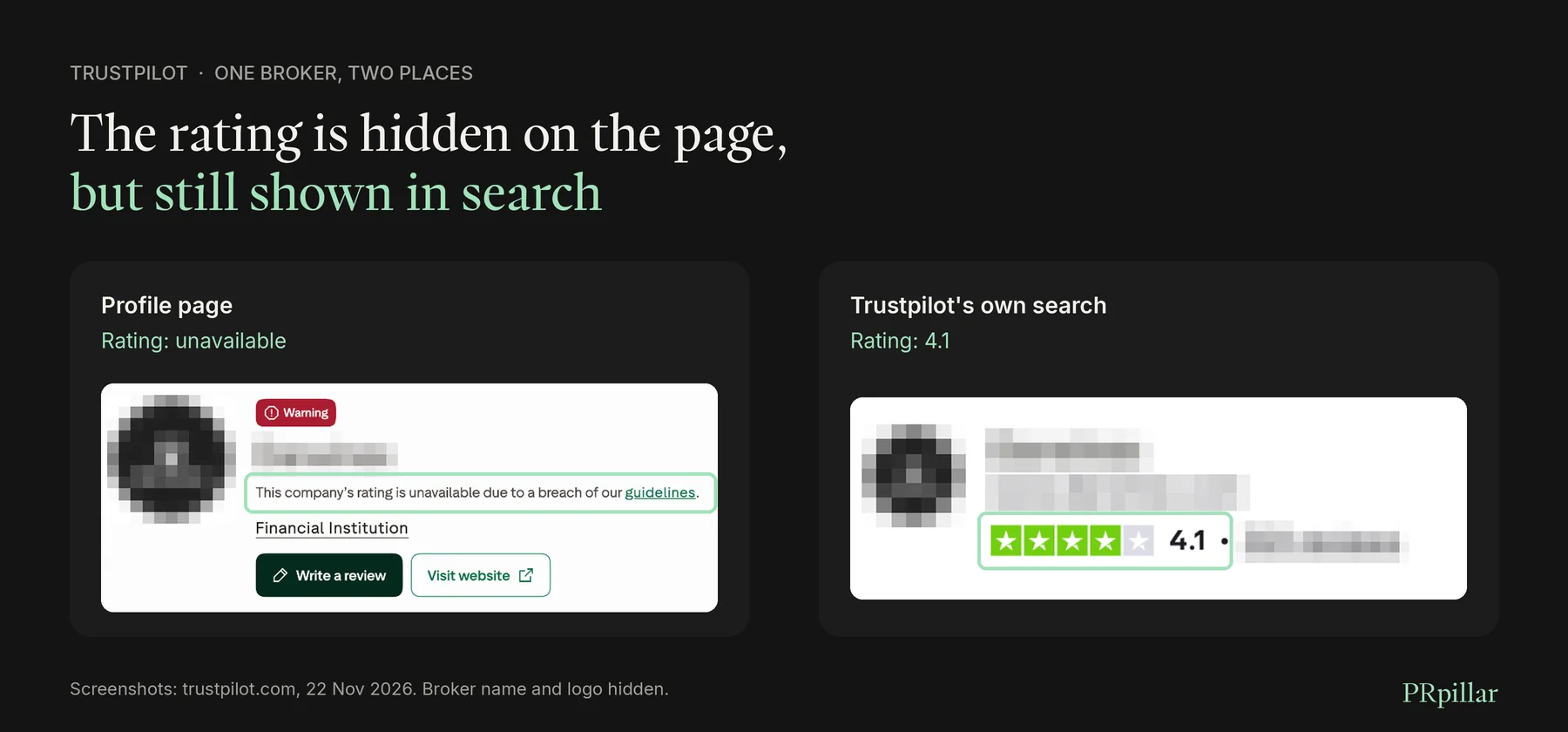
Trustpilot is also a source. We looked at the profiles of 94 CFD/FX brokers, and 21 of them (22%) have a red banner. On 19 of them the profile page hides the rating, it says "rating is unavailable". But if you search for this brand in Trustpilot's own search, the score is still there as a number, for all 19. And 62 of 94 have at least one more profile with the same name in the top 10, sometimes with a much lower score. A person usually opens the main profile and that's it. AI can take any of them. Plus Trustpilot is less predictable now: a lot of brands get a final warning, and deletions happen without a clear reason.
Some broker sites are closed for AI. We checked 79 sites of brokers and prop firms, and 14 of them (18%) refused an AI bot at least once, but let Google's bot in normally. And the funny thing: in 13 of the 14, robots.txt (the file where a site tells bots what they can read) directly says: AI bots, welcome. So on paper the site allows AI, but the security settings (the firewall) still block it. Two settings say opposite things, and marketing most probably doesn't even know. And if AI can't read your site, it answers from other people's pages. One note: we sent the requests from our own servers, so real bots can be treated differently.
Licenses matter a lot. What I see right now: LLMs are super tied to licenses. FCA or CySEC is cool, offshore a bit less cool, and if you're unlicensed, most probably nobody will ever mention you in the tops. And with outdated licenses it's a separate story: the license has been gone for a few years, and AI still names it, just because some outdated page is still hanging somewhere.
Several companies, one name. Many brokers run several licensed companies under one brand, for different regions. AI can take the wrong one, for example show a UK user the license or withdrawal page of another region. Sometimes it's not even you: I open a page and at first I think it's the broker, but it's actually a different company with a similar name, not verified and with no license.
What AI reputation management services include
- Real questions. Nobody has real prompts now, because there are no open statistics for ChatGPT like Google Analytics or Keyword Planner. The only way right now is to see what real traders ask in Google and use the same in AI. Sometimes people ask us: okay, you picked these prompts, prove they're real. And I'm like, there are no such statistics. But "is [broker] legit" is a real query people type in Google, so most probably they type it in AI too. They just changed the interface. A Google question is just a keyword written as a question, and it's the best way to guess real prompts. It won't be 100% the same as what a user types into Claude or ChatGPT, but the intent will be the same.
- Languages, not only countries. Google and AI mostly rely on the language. If you type an English question in Google sitting in the UAE, most probably you will get almost the same results as in the UK. But local markets can add their own questions too. For example, for Arabic markets we also check questions like "is it halal or haram?".
- Three layers. The first layer is the answer itself. The second is the links it cites. The third is the content of those pages. That's where we find the old license, the old risk figure, the old offer.
- Fixing. A page on your own site is actually the fastest way to influence AI, I don't know why people underestimate it. If a license changed, write it clearly on your official site. Finding the problem is one thing, how to solve it is another question, and sometimes it's SEO methods, sometimes you change the content, maybe create an article on your website. With media we ask to correct facts if there are points we can suggest, and we respect their position on their own content. Plus the work with review sites, Reddit, Quora and all the other sources AI takes its information from.
- Checking again. People call it AI reputation monitoring. Usually you set fixed prompts and keywords and don't change them, otherwise you lose track of whether something changed. And you need to run the same queries regularly, because ChatGPT gives different sources each time.
Before fixing anything, you should start with quite deep research of the brand's reputation in AI and Google. With data you believe what you see yourself in the answers and on the pages, not what some tool or chat told you. It annoys me when people publish research and there's not even raw data to check. For this part I co-founded Symoditi. It looks at what AI and Google say about the brand, for different questions, countries and languages, and where they take it from. But fixing is already manual work, and this is what online reputation management (ORM) agencies do, our team at PRpillar included.
What Answer Reputation Management can't do
I tell you honestly, nobody in the world knows what exact prompts people use. No tool has access to ChatGPT or Grok data about what real users ask, so every tool just shows you what they think users do. We also guess, we just guess from real Google data.
And because the variability is so high, most probably we won't get an exact match like with Google keywords. Every user types the text in their own unique way, and the volume of data is too big. Maybe there will be tools that can detect it, but I assume it will be based on intents. It won't be the exact phrases users type, because there's an endless number of them.
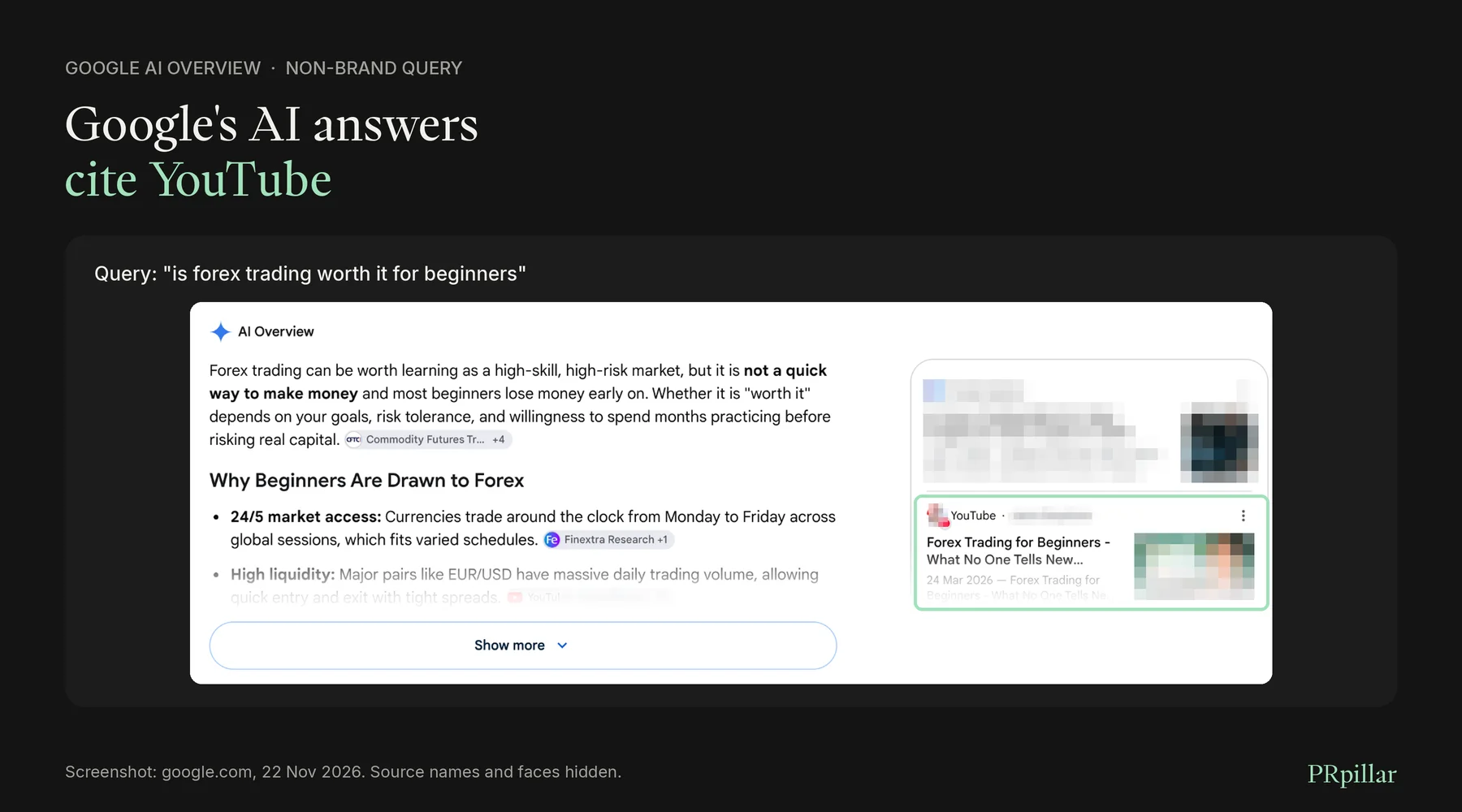
Second thing is time. Even if you know what to fix, it will not work in one day for sure. What AI takes from the web changes somewhere from a couple of days to 2 months, it depends on the source. And right now the rules are changing a lot, and very fast, every two or three months. Since we launched our tool, almost every AI changed something radically in how it cites, one or two times for sure. But at the same time we see specific sources that stay, even when the model changes a lot, and most probably they will stay. For example, YouTube, Quora and Reddit. From what we see, answers on Quora can completely change Google's answers, and within 2 to 4 weeks. And even when a model changes its approach, if it prioritizes Quora, most often Quora stays in the set. The same with YouTube: it's part of Google, so Google will always prioritize it, and working with YouTube definitely shapes Google's AI answers, in AI Overviews and in AI Mode. Part of what AI says about a brand is also stored in the model's own memory, not only pulled from the web, and as far as I've read, that memory changes in about 6 to 12 months. So you need to check again on fresh data.
FAQ
What is online reputation management?
Online reputation management (ORM) is broader. It's about how people see your brand and its reputation in general, from any source. It includes SERM (search engine reputation management), so the work with search results. It includes the work with AI, this is AI reputation management, or as we call it, Answer Reputation Management. And even social media, sometimes people call it separately. So AI reputation management is just one part of online reputation management.
Can you remove a negative AI answer?
Directly, no, there is no "delete" button. But you can change what the answer is collected from: old pages, wrong facts, pages you just don't have on your site. My personal opinion: any content that reflects the truth and is not written to hurt the brand is okay. Unless the AI system itself distorts the facts. If a page tells the truth, but AI twists it so that it hurts the brand, that's already not right. This is a question to the developers of AI models, and we can't change them right now. We can only influence what we can, and that means this still gets solved through the sources. But old and wrong facts are something else, and those you can fix.
How to fix brand reputation in AI answers?
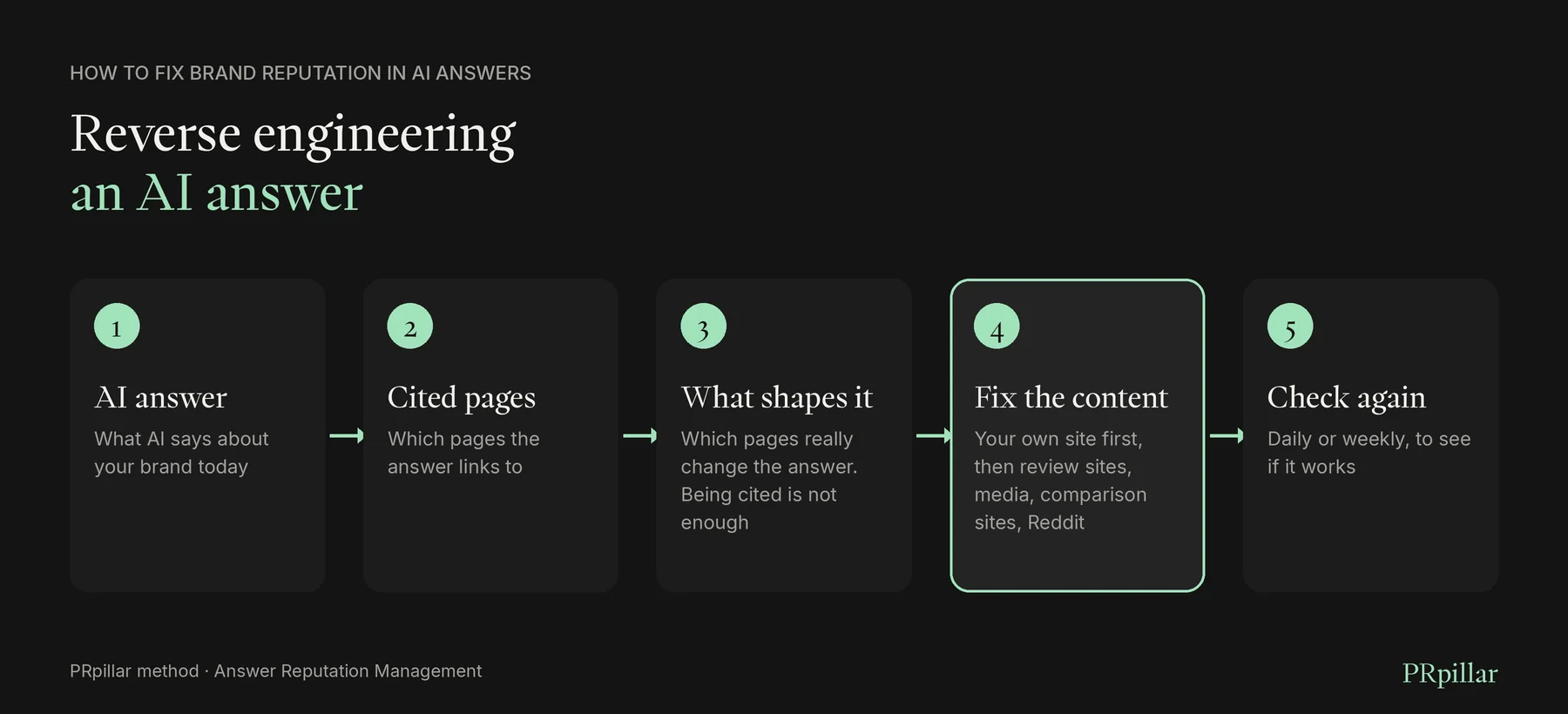
Basically it's reverse engineering: you go from the answer back to its sources. You look at the answer, then at the pages it links to, then at which of them really influence the answer, because not every link changes it. Then you fix what influences it: your own site first, then review sites, media, comparison sites, Reddit. And what you influence you check every day or every week, to understand if it works or not.
How long does it take?
In general, models are not slow and pick up changes quite fast. It depends on the specific model, but there is the model's own memory, and there is what it takes from the web. What comes from the web you can change, sometimes even in a couple of days. For example, Reddit threads can get indexed in a couple of days, and AI can pick them up. Answers on Quora take about 2 to 4 weeks, a YouTube video about 1 or 2 weeks. In general it can take up to 2 months. It all depends on the specific query and question.
Which AI matters for CFD brokers & Fintech?
Different AIs take different sources, so it's not only ChatGPT reputation management: you need to check each one that is popular in your markets.
- ChatGPT
- Google: AI Overviews, AI Mode and Gemini
- Microsoft Copilot
- Claude, Perplexity, Grok
- Meta AI
- DeepSeek, Sakana from Japan and other local AIs in your markets
And not all of them give a country-specific answer, mostly it's Google that does. If you want an answer for a specific country, you need to put the country right into the question.
Is it a compliance topic?
Old data is for sure a marketing topic, and most probably compliance too. Honestly, I hope CySEC and other regulators won't make brokers responsible for what AI says about the brand, like it is now with affiliates.
How can I check my own brand quickly?
Take a basic set of questions for your main market and check them both in AI and in Google. And don't forget about Google, Google is the base. In our November export (17 brands, 33 countries) three checks come up for almost every broker in every country. The percent is in how many "brand + country" pairs people searched it at least once. So whatever broker and country you take, most probably people search this:
- "[your brand] review": 99% (320 of 324 pairs);
- "is [your brand] legit?": 91% (294 of 324);
- "[your brand] withdrawal": 86% (278 of 324).
And scam. In Google people often type it just as a keyword, "[your brand] scam" (89% of pairs), and the same intent comes as a question too, "is [your brand] a scam?". If people type a keyword like this in Google, most probably in AI they ask it as a question. You can also add the country right into the prompt, like "is [your brand] legit in the UAE?", then you see the local sources better. Most probably you will see the basic problems already there. Then check which pages the answer links to. You can start manually, and later, if you want to do it on a regular basis, use additional tools for it. We constantly monitor prompts and keywords in fintech and CFD, so maybe we already have data on your brand for the previous period. Just write to us and we'll check. If we have it, we'll send it to you. If not, we can start collecting it, if it makes sense for us too.
Do we already have data on your brand?