How Two Quora Threads Shaped an Entire Brand's Reputation in Google Search and AI Answers
The Brand
A freshly launched trading education brand, entering a competitive market from day one with no existing online presence. The brand's primary growth channel was Reddit — that's where the core community-building effort was focused. Quora was a secondary front, with a deliberately limited budget.
Despite working across multiple services, the scope on Quora was intentionally minimal. The brief to PRpillar was simple: get the maximum possible visibility out of the smallest possible investment.
That constraint is exactly what makes the results worth paying attention to.
The Starting Point: A Brand Nobody Could Find
Before we stepped in, the brand's search presence was essentially non-existent. Here's what we were working with:
Challenge #1 — Zero Presence in SERPs and AI Results
The brand had almost no visibility in either Google or LLM-generated results. Searching for the brand returned only the official website — no third-party content, no reviews, no discussion threads. Nothing to build trust.
Challenge #2 — Brand Name Overlap with Unrelated Businesses
The brand name was an abbreviation shared by at least four different companies. When users searched for the brand, they found a confusing mix of results from completely unrelated businesses.
Even worse: AI models were generating summaries that combined information from all these different companies — creating inaccurate, misleading brand representations that were completely beyond the company's control. And because there were so many irrelevant results competing for attention, even the brand's own official website was being outranked or buried on page two or beyond.
The core problem: The brand didn't just lack visibility — it was actively being misrepresented by Google and AI systems that had no reliable source of accurate information to draw from.
What We Did: Building a Narrative from the Ground Up
Given the budget constraints, we needed a high-leverage approach. We focused on a single platform that we knew could punch well above its weight: Quora.
The Strategy: Discussion-Based Visibility
We created targeted questions and posts on Quora that incorporated brand-related keywords. But not just the obvious ones — each month, we rotated different keyword combinations to ensure broader indexation across search engines:
Brand's full name
All brand abbreviations
Brand + "review" / "reviews"
Brand + related use-case queries
This approach meant the same two discussion threads could rank for multiple variations of brand queries — rather than being optimized for just one fixed keyword.
Why Long-Form Content Was the Key
Short, shallow content wasn't enough. We invested in extended, context-rich answers that gave both search engines and AI systems enough substance to understand the brand's positioning, use cases, and value proposition.
This is critical for AI visibility in particular: LLMs don't just index keywords — they extract meaning. By consistently framing the brand narrative within detailed, informative content, we created a reliable signal that AI models could reference when generating brand-related summaries.
The budget reality: We worked with two Quora threads, created in August 2024, maintained on a non-monthly basis due to budget limitations. These results were achieved with minimal effort — which makes them even more compelling.
The Results
1. Google Search Visibility
Both discussion threads were successfully indexed by Google. We agreed to track 16 brand-related keywords across 15 countries.
Despite working within tight budget constraints, here's what those two threads achieved:
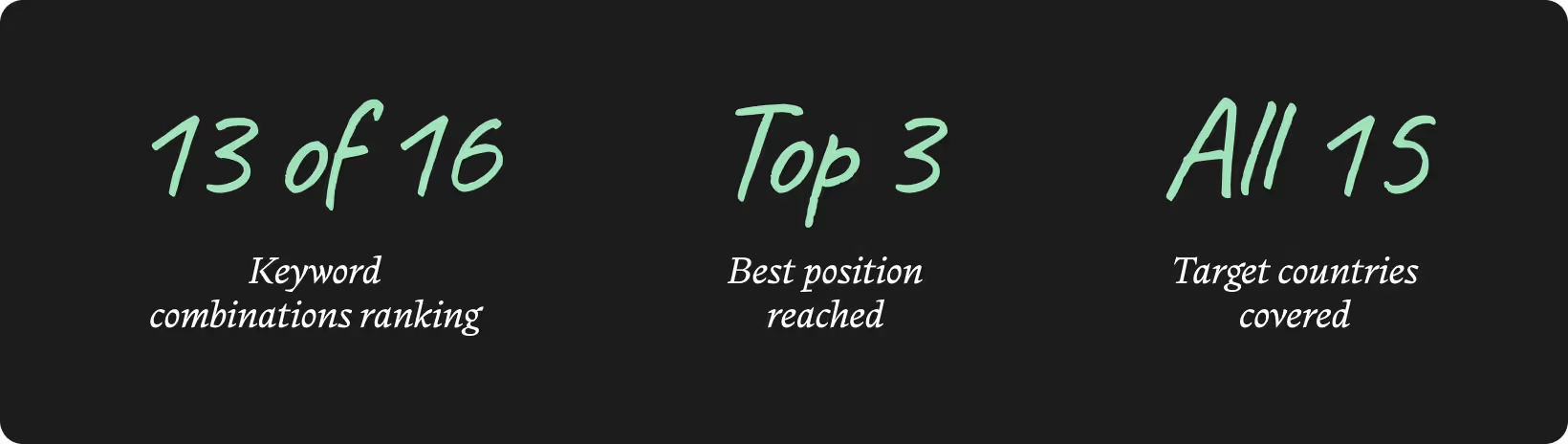
Think about what this means in practice: almost any way a user searched for the brand — whether by full name, abbreviation, with "review" appended, or in any of 15 different countries — they encountered the Quora threads that we controlled. Threads that told the brand's story accurately.
This was a complete transformation from the initial state: from having zero supporting content in search results, to achieving consistent Top-3 placements across the board.
Below is the trend chart tracking the positions of both links in Google for brand-related keywords. The percentage shows how frequently users would encounter the links when searching for the brand, relative to all competing links:
.avif)
As of January 21, 2026: Link #1 ranks as the most popular result across 223 keyword & country combinations. Link #2 holds rank #23.
2. AI and LLM Visibility
This is where the results get especially interesting. Remember the original problem — AI models were generating inaccurate brand summaries by pulling from irrelevant businesses with the same name. Once our Quora threads were established, that dynamic changed significantly.
To measure AI visibility systematically, we tracked the following setup:
3 prompts:
"What is BRAND_NAME?"
"What are the reviews about BRAND_NAME?"
"Can you give me a BRAND_NAME review with pros/cons?"
15 countries: AE, GB, IN, SG, US, ZA, CA, AU, PH, NG, DE, FR, ES, IT, NL
8 LLMs: Google AI Mode, Gemini, ChatGPT, Claude, DeepSeek, Perplexity, Copilot, Grok
Here is a summary of the key statistics from our AI visibility tracking:
.avif)
Breakdown of Link #1 citations across LLMs:
Claude: 30 citations
Google AI Mode: 33 citations
Grok: 44 citations
Google AI Overview: 1 citation (during SERP tracking)
Link #2 (Grok only): 10 citations
Our two Quora threads appeared across 103 out of 317 AI requests — that's 32% of all AI answers referencing our content. For the exact query “"what are the reviews about this brand?", it climbed to 43%. In other words, when someone asked a Claude, Grok or Google AI Mode "what are the reviews about this brand?", there was almost a 1-in-2 chance the AI cited our content.
Important AEO context: Our threads were not cited by all 8 LLMs — and that's expected. Each model applies its own criteria for selecting sources. This is the nature of Answer Engine Optimization (AEO): understanding which models prioritize which signals, and adapting your strategy accordingly.
The Bottom Line: You Don't Need to Dominate the Whole Web
This case is a proof of concept. With two threads, a tight budget, and a focused strategy — we shifted a brand from being misrepresented by AI systems to being accurately described in nearly a third of all AI-generated responses.
The brands that will win in the next era of search aren't necessarily the ones with the biggest budgets or the most content. They're the ones that understand where the signals are coming from — and build the right content in the right places to influence both search algorithms and AI reasoning.
The question isn't whether AI systems are reading about your brand. They are. The question is: what are they finding?